
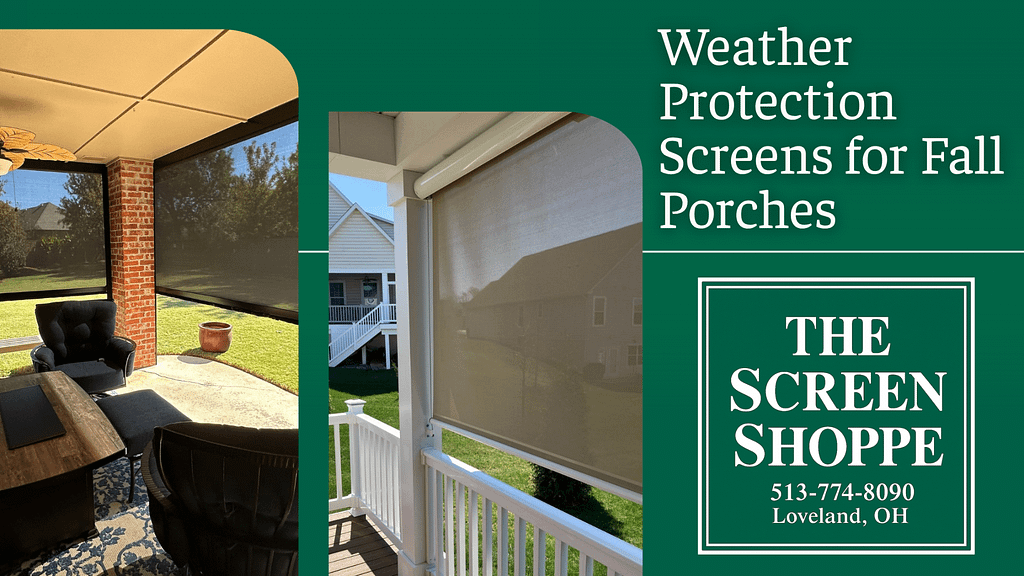
A front moves through Loveland on a Tuesday afternoon in late September — clear sky at noon, gusts and sideways rain by two o’clock, sun again by four. That’s a normal week of Ohio fall weather, and it’s also the exact reason so many covered porches sit empty from Labor Day on. The furniture gets a tarp, the cushions come inside, and everyone waits for a calmer season that doesn’t really arrive until next May.
The porch itself isn’t the problem. A roof overhead handles rain falling straight down without any trouble. What it can’t handle is rain blowing in sideways, which is what a fast-moving front does to an open-sided porch in Blue Ash or Hamilton — comfortable one minute, soaked the next. At The Screen Shoppe, we’ve been solving that specific problem for Loveland, Mason, West Chester, and Greater Cincinnati homeowners since 2001, and weather protection screens are the product built for exactly this stretch of the calendar.
Bugs and Sun Fade. Wind and Rain Don’t.
Every conversation we have about porches from May through August is about mosquitoes and sun. By September, both ease up — mosquito activity drops off, and the lower sun angle takes glare and heat out of the equation for most covered porches in Cincinnati and Montgomery.
What takes their place is wind-driven rain and the kind of gusty, fast-moving front that shows up across Ohio with little warning in early fall. An insect screen or a solar screen was never built to stop that. Both are designed to filter light and keep bugs out, not to hold back weather moving at an angle.
What Cincinnati Actually Deals With Each Fall
It helps to put a number on “unpredictable.” Greater Cincinnati averages around 12 rain days and roughly an inch and a half of precipitation in September, with average wind speeds near 9-10 mph. October brings less frequent rain — closer to 6 days — but the storms that do roll through tend to carry more punch, with average wind speeds climbing toward 12 mph and monthly precipitation jumping to around 3.5 inches.
Averages don’t tell the whole story, though. The wind and rain that catch a porch off guard almost never show up as a steady, predictable drizzle — they arrive as a fast-moving front, the kind that can turn a calm afternoon into a soaked one in the time it takes to notice the sky changing. That’s the specific window weather protection screens are built for, not the mild, sunny days fall in Ohio is also known for.
Same System, Different Fabric
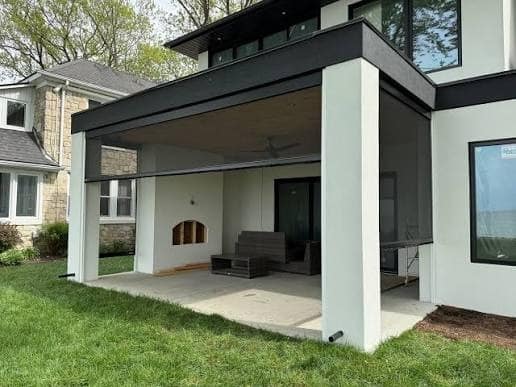
Weather protection screens run on the same Rainier Retractable Screen system as every other screen we install — same Somfy motor, same housing, same one-button control through Somfy myLink. The difference is the fabric: a denser, tighter weave engineered to resist wind pressure and shed water instead of letting it pass through.
Rainier builds these screens around what’s known as a Side Retention System, which holds the fabric edge captured in a track on both sides rather than letting it float free. It’s a meaningful detail if you’ve ever dealt with a cheaper screen that pops out of its track or flaps loose in a stiff wind — the retention system is what keeps the barrier intact instead of just decorative. The screens themselves are field-tested in heavy wind conditions and sized to fit almost any opening, from a small porch window up to large openings spanning several feet wide and well over head height, so a wraparound porch and a single sliding door opening can both run the same system.
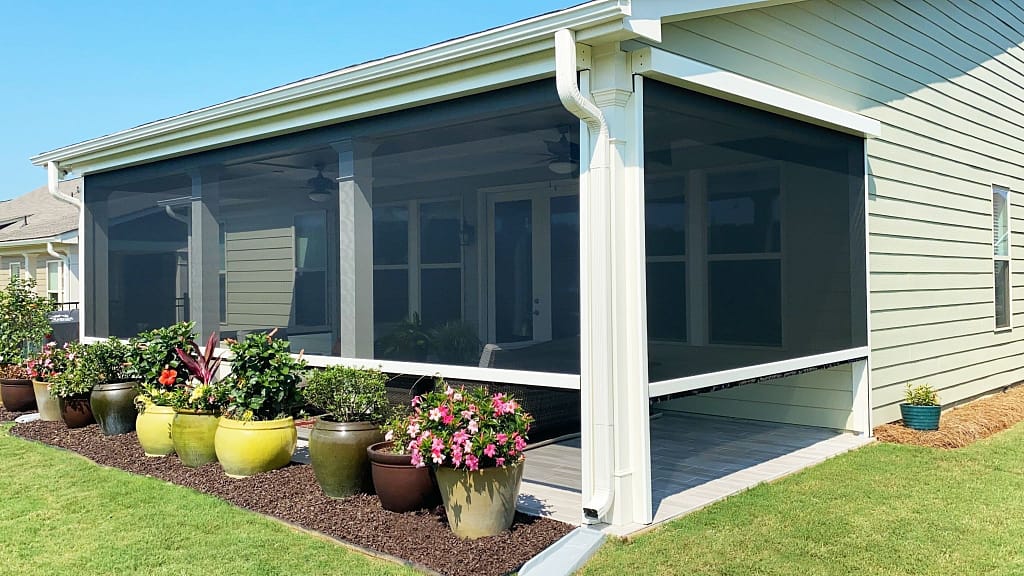
Worth being upfront about one limit: on a truly sideways, wind-whipped downpour, the mesh will let through some light misting, even fully deployed. That’s a physics-of-mesh issue, not a defect, and it’s a very different scenario from the wind-driven rain that ruins an afternoon on a fully open porch. Deployed, the screen creates a real barrier along the open side of a porch, patio, or deck — enough to keep the furniture, flooring, and anyone sitting outside from taking the brunt of it. Retracted, it disappears into the housing exactly like our insect or solar screens do, so the same porch can be closed against Tuesday’s storm and wide open for Saturday’s cookout.
Control Options Beyond the Wall Switch
The one-button description undersells what Somfy myLink actually does. Beyond a wall switch, myLink turns a smartphone or tablet into the remote, so a screen can be deployed or retracted whether you’re standing on the porch or already at work when the forecast changes. The system also integrates with smart home setups, which means a weather protection screen doesn’t have to be a separate gadget to remember — it can fold into whatever automation a homeowner already has running the rest of the house.
For a lot of families, that’s the difference between a screen that gets used and one that gets forgotten. A wall switch only helps if someone’s home and thinking about the weather. A phone app means the screen can go down before a 2 p.m. front even shows up on the porch.
Why the One-Button Part Actually Matters
A storm front doesn’t wait for you to clear the porch. Because the system is motorized, dropping the screen takes one press, not fifteen minutes of hauling cushions inside while the sky is already turning. That’s the practical gap between a porch that’s still in use through October and one that got covered up the first week of September.
What Installation Day Actually Looks Like
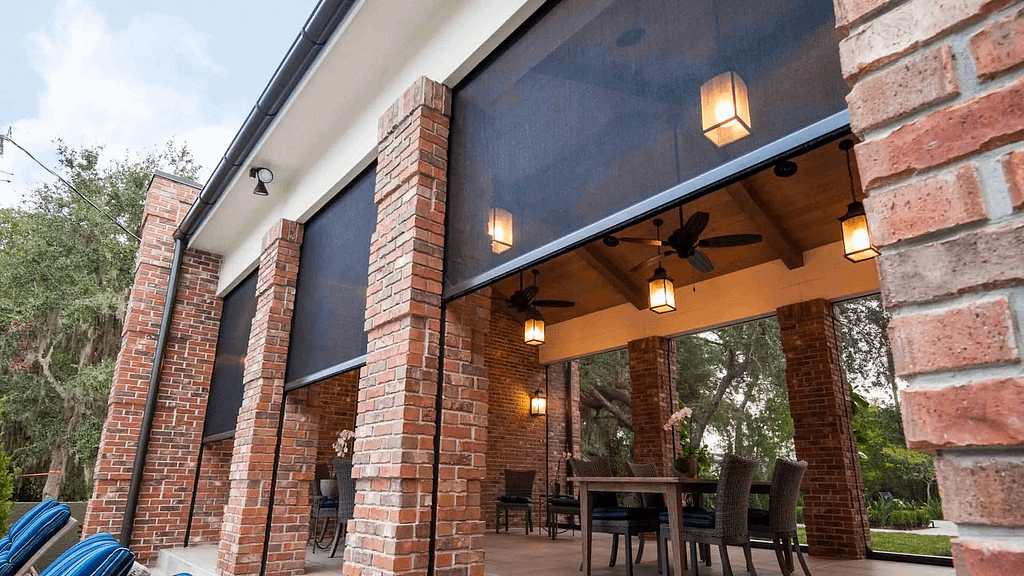
Most retractable screen installations are finished in a single day, whether it’s a new-construction project or a retrofit on a porch that’s already built. The two approaches look different. New construction gets the screen tracks recessed into the columns and the housing hidden inside the header, so the finished look is close to invisible when the screen is retracted. A retrofit mounts the housing under the existing header and runs the side tracks on L-brackets along the columns — a little more visible, but with 16 housing color options, it’s built to blend with the house rather than stand out against it.
Either way, it’s our own installation team on the job, not a subcontractor crew showing up under our name. Estimates are by appointment, and they’re fast and free — someone measures the actual opening, walks through fabric and housing color options, and gives a straight answer on what it’ll cost before any commitment gets made.
Keeping It in Good Shape Once the Weather Turns
A weather protection screen holds up better over time with a little basic care, the same as any of our screen products. Clean the mesh periodically with a soft brush and mild soapy water, then rinse gently — skip the pressure washer, which can damage the mesh over time. Keep the housing and track clear of leaves and debris, especially heading into a season when both tend to pile up. And during the heaviest wind, rain, or eventual snow, retracting the screen fully protects both the fabric and the frame better than leaving it deployed around the clock.
None of this is a big time commitment. It’s closer to the kind of five-minute check a homeowner already does on gutters or a grill cover before winter sets in.
Where It Fits With What You Already Have
If you added an insect or solar screen from us earlier this year, weather protection often becomes the piece that finishes the job — same housing, same motor, just a fabric swap or an addition to a different opening. And for homeowners with larger covered porches in Loveland, Mason, West Chester, Hyde Park, Anderson Township, or Milford, it works well alongside a fixed porch enclosure: the enclosure handles the permanent, structural side, while the motorized screen gives you the option to open things back up on a calm afternoon.
A retractable awning solves a related but separate problem — overhead shade on patios that have no roof at all, not wind or rain coming in from the side. SunSetter awnings and Rainier Shade systems include their own wind sensors for that reason. Some properties end up using both; which one you need depends on whether the issue is what’s falling from above or what’s blowing in from the side.
We’ve been the family-owned name behind these installs in Loveland for more than two decades now, and the reason a lot of customers call us for weather protection screens, awnings, and enclosures instead of three different companies is simple: one call covers the whole porch, not just one piece of it.
Booking Before the Rush That’s Already Started
We’re already seeing the fall pattern repeat: homeowners who wait until mid-October to call have usually missed several weeks of genuinely good porch weather in the meantime, and our schedule fills fastest in the weeks right after Labor Day. Our own installation team handles every job, and estimates are by appointment, fast, and free.
A Few Questions We Hear This Time of Year
Does a weather protection screen work on a completely open patio, with no roof at all? Not on its own — it blocks what comes in from the side, not from directly overhead.
Will it really keep rain out completely? In a straight-down rain, yes. In a truly sideways, wind-whipped storm, expect some light misting through the mesh — the screen is still doing its job cutting the wind and the bulk of the water, just not creating a hermetically sealed room.
What’s the warranty on these? Coverage is backed by the manufacturer and varies by product line and fabric choice. We’ll walk through the specifics for your exact setup during the estimate rather than quoting a blanket number that may not apply.
Get More Out of Fall in Greater Cincinnati
If your porch usually gets shut down the first week of September, get in touch now rather than after the next front rolls through. Get In Touch Today to schedule a free estimate, or call (513) 774-8090.