
When Greater Cincinnati homeowners start looking into motorized retractable screens, most assume all options are essentially the same — something that drops down to keep bugs out. That assumption changes quickly once the choices get laid out. The Screen Shoppe installs three distinct screen types, and each one is built for a different set of problems. Choosing the right one isn’t complicated, but it does require knowing what’s actually keeping you off your porch.
This guide breaks down all three: insect screens, Textilene Nano 95 Solar Screens, and weather protection screens.
What All Three Have in Common
Before getting into the differences, it helps to understand the foundation. Every motorized retractable screen The Screen Shoppe installs uses the Rainier Motorized Retractable Screen system, powered by Somfy motors, widely recognized as the world leader in tubular motors for exterior shading. The mechanics are consistent across all three types: the screen retracts fully into a housing unit above the opening when not in use and drops into position at the touch of a button. The Somfy myLink system allows control via smartphone and can group multiple screens to operate at the same time.
Systems are available in 16 housing colors to match your existing exterior. New construction installs integrate the housing fully into the soffit. Retrofit installs on existing covered porches, patios, and decks use surface-mounted hardware. Both approaches are available for homeowners throughout Greater Cincinnati, from Loveland and Mason to West Chester, Montgomery, Blue Ash, and the South Dayton corridor.
What changes between the three screen types is the fabric. Same motor, same system, same installation process — different material, different job.
Insect Screens: The Foundation for Bug-Free Evenings
If the primary reason your porch goes unused from May through September is mosquitoes, gnats, and flies, insect screens address that directly. The fabric has a fine, open weave engineered to block insects while maintaining strong airflow through the opening. Fresh air circulates, natural light comes through, and the space feels open. So you can forget about bugs making warm Ohio evenings genuinely unpleasant.
When insect screens are the right fit
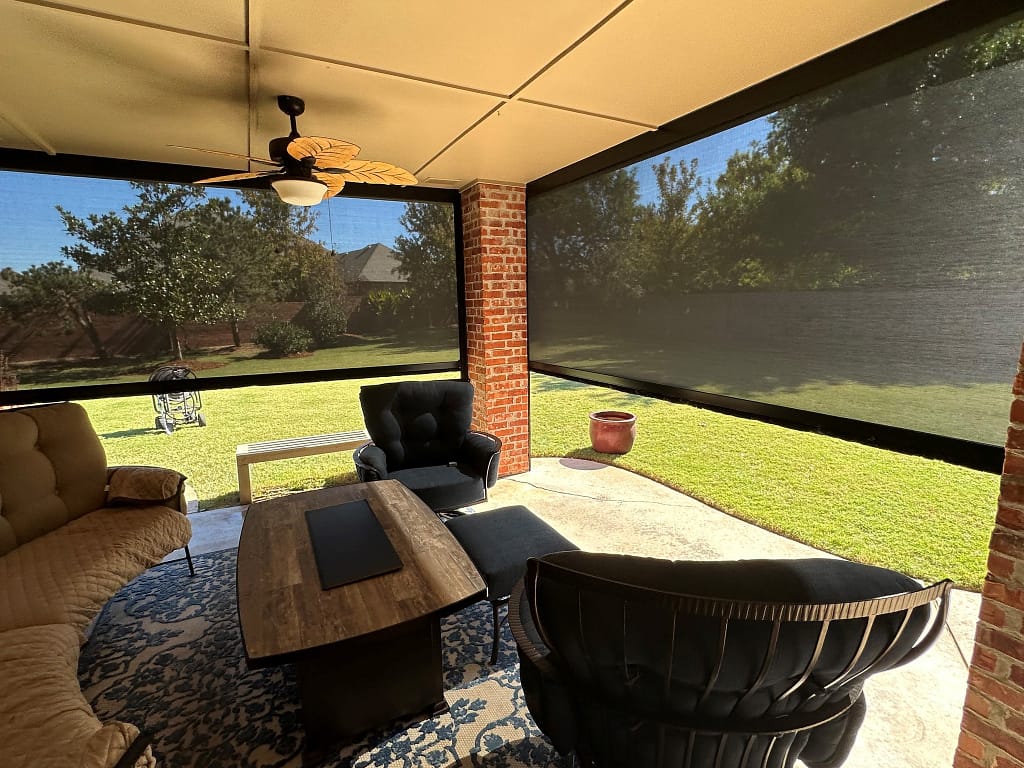
Greater Cincinnati summers bring consistent insect pressure from late May through early fall. Mosquitoes peak in July and August around Loveland, Mason, West Chester, and Hamilton, and evenings on an unscreened porch can go sideways fast. If bugs are the main problem and your porch is shaded or north-facing, insect screens are very likely all you need.
This is also the right call when heat and glare aren’t factors. A north or east-facing porch that sits in shade through the afternoon isn’t collecting sun, so there’s no reason to pay for UV-blocking fabric if heat isn’t what’s driving you inside.
What insect screens won’t do
Insect screens will not reduce afternoon heat on a south or west-facing porch in July. They won’t add privacy from a neighboring yard or a street. If either of those issues is present, a different screen type setup will serve you better. That’s a conversation worth having during the estimate.
Textilene Nano 95 Solar Screens: Heat, UV, and Privacy
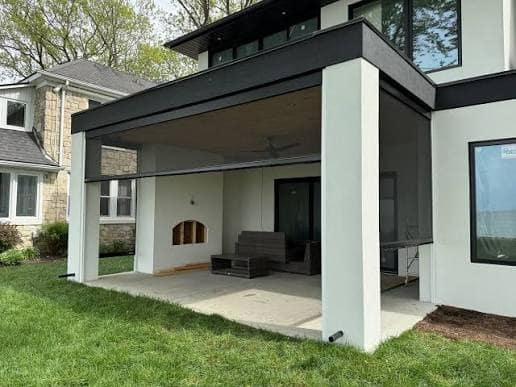
Solar screens take the insect-blocking function and add meaningful heat and UV management. The Textilene Nano 95 fabric blocks up to 97% of UV rays and reduces solar heat gain — which makes a measurable difference on any porch or patio with significant sun exposure.
This is the most commonly requested screen type for homeowners dealing with south or west-facing outdoor spaces in Greater Cincinnati. By mid-July, a west-facing patio in Mason, Montgomery, or Blue Ash can be genuinely unusable from around noon until well after dinner. Solar screens change that equation.
What the 97% UV figure means in practice
UV blocking at that level protects everyone using the space from prolonged sun exposure, but it also extends the life of patio furniture, cushions, outdoor rugs, and any deck surface that takes consistent direct sun. Fabrics fade. Composite decking bleaches. Solar screens slow that process considerably. It’s a practical benefit many homeowners don’t think about until they’ve already replaced outdoor furniture once.
The Textilene Nano 95 fabric also adds meaningful privacy from outside. The denser, darker weave makes it difficult to see clearly into the space from a street, sidewalk, or neighboring yard. From inside the screen, the view out remains clear. From outside, it’s substantially obscured.
When solar screens are the right fit
South or west-facing patios with direct afternoon sun exposure are the primary candidate. Solar screens are also the right call when privacy is part of the equation. Homeowners in closer-in neighborhoods — Hyde Park, Norwood, Kenwood, Anderson Township — or on smaller lots throughout the Loveland and South Dayton areas often find the combination of heat reduction and visual privacy worth the step up from a basic insect screen.
What to keep in mind
The Nano 95 fabric is denser than a standard insect screen, which means airflow is reduced somewhat. It’s not exactly a solid panel, so ventilation still comes through the fabric, and the open, breezy feel of an insect screen hits a little different. For most homeowners who install solar screens, that tradeoff is reasonable given what they’re getting in return.
Weather Protection Screens: Wind, Rain, and the Shoulder Seasons
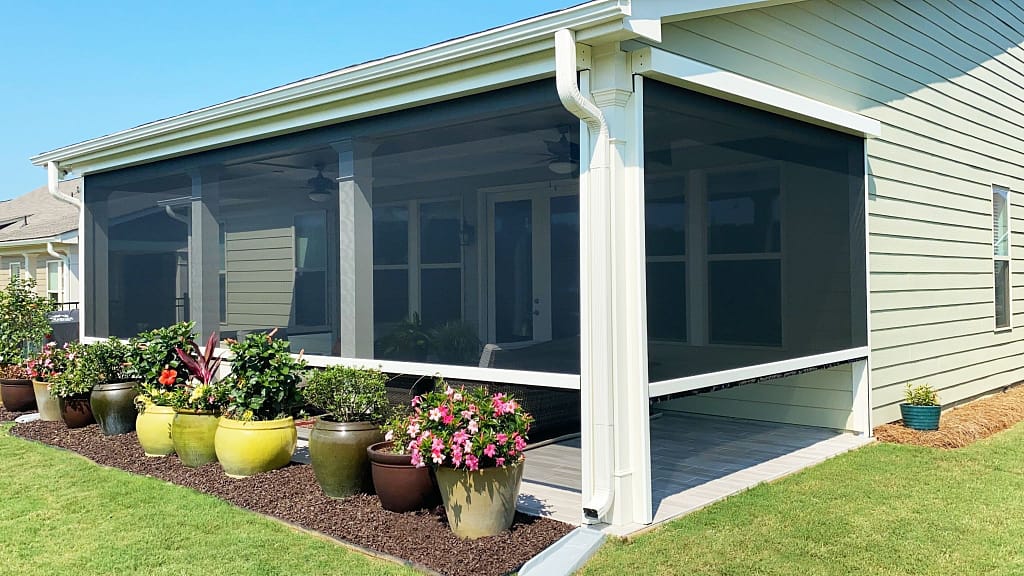
Weather protection screens handle what insect and solar screens weren’t built for: actual weather. These screens block wind, rain, and driving precipitation from entering a covered outdoor space, which fundamentally changes how many months of the year that space is usable.
In Greater Cincinnati and the South Dayton area, fall evenings cool down quickly, and the shoulder seasons — September through October, and again in March and April — bring genuinely variable conditions. A comfortable outdoor evening can shift fast once the temperature drops or a front moves through. Weather protection screens mean you don’t have to go inside when it does.
What weather protection screens actually do
The fabric is heavier and more tightly woven than the other two types. Wind that would blow straight through an insect screen gets substantially reduced. Light rain that would still reach furniture on a covered porch gets blocked at the screen. These systems don’t make a porch airtight, but they extend the range of conditions under which the space is genuinely comfortable.
For homeowners who want to get real use out of their outdoor space from early spring through late fall in Ohio, weather protection screens are what make that realistic. Insect and solar screens handle the summer months well. Weather protection screens handle the shoulder seasons that the other two types don’t touch.
When weather protection screens are the right fit
If you’re investing in your outdoor space and want to maximize how many months of the year it’s usable, weather protection screens deserve to be part of the conversation. Homeowners in Springboro, Centerville, Beavercreek, and throughout the Dayton area often ask specifically about season extension because the weather there runs cooler and windier earlier in fall than in central Cincinnati.
This type also makes sense for any covered porch or patio that faces into open yard with limited windbreak — a side porch that takes a consistent prevailing wind on September evenings, for example, or a rear patio that’s comfortable through July but exposed once temperatures drop.
Using Multiple Screen Types on the Same Space
One option homeowners often don’t consider right away: you’re not locked into a single motorized retractable screen type for an entire space. A wraparound porch with multiple openings — some sun-exposed, some shaded, some facing into prevailing wind — can run different screen types on different sides based on what each opening actually needs. Insect screens on the north-facing shaded side. Solar screens on the west-facing opening that collects afternoon sun. Weather protection screens on the side that takes wind and rain.
The Screen Shoppe walks through this during the estimate conversation. It’s more common than most homeowners expect going in, and the motor system handles it cleanly. Multiple screen types can be grouped and operated independently or together through the Somfy myLink app.
A Simple Framework for Choosing
Working backwards from what’s specifically keeping you inside is the fastest way to figure out the right fit.
- Bugs are the main problem, and the porch is shaded or north-facing: insect screens are very likely all you need.
- Afternoon heat or glare is making the space unusable, or privacy from a street or neighboring yard is a factor: Textilene Nano 95 Solar Screens.
- You want to use the porch in September and October without going inside every time the wind picks up or the temperature drops: weather protection screens.
- Multiple problems across different openings: a combination. This comes up often with larger covered porches and wraparound configurations.
Still not sure? A free estimate is the right first step. The Screen Shoppe has been helping homeowners across Greater Cincinnati and the South Dayton area sort this out since 2001. An estimate includes a specific recommendation based on your porch layout, your particular frustrations, and how you actually want to use the space.
What the Installation Process Looks Like
Regardless of screen type, the process works the same way. The Screen Shoppe measures each opening precisely — every screen is custom-fabricated to fit the specific structure, not cut from a standard size. Our own installation team handles the job from start to finish, with no subcontractors and no third parties.
Installations are available throughout Greater Cincinnati and the South Dayton area — Loveland, Mason, West Chester, Montgomery, Blue Ash, Hamilton, Anderson Township, Milford, Madeira, Springboro, Centerville, and Beavercreek, among others. Fast, free estimates. Appointment-based scheduling with no pressure to decide on the spot.
Get Started with a Free Estimate
Whether you know which screen type fits your space or you’d like to talk through the options first, Get In Touch Today to schedule your free estimate. You can also reach The Screen Shoppe directly at (513) 774-8090.
Fast, free estimates. Our own installation team. Serving Greater Cincinnati and South Dayton since 2001.